Free Language Classes in Pittsburgh

Free Language Classes in Pittsburgh

Hi dear readers,

It’s been a while, as usual. This time, I have been actually really very busy. As I stated in some previous post (or did I at all?), I have taken some 5 grad courses, I have research to do and then I have a part time job for which I have to pull all-nighters twice a week. So, I am pretty busy. I have been unable to keep up with new anime even. However, I do find time to go to anime club every week. I have missed only twice this semester. I have been to quite a few movies as well and meet friends not from my department at least bi-weekly. Now that I have written it down, I realize I am really enjoying this sem. And then, I have joined these free language classes which will be the main focus of this post.

One of my Chinese friends knew how interested I was in languages (she herself is a big fan of Big Bang and hence is interested in learning Korean) and she took me to these free language classes that are held in Carnegie Library of Pittsburgh (by volunteers I think, not sure). I have joined Korean, which is held every Saturday, Japanese which happens every other Monday and the Russian which happens every alternate Thursday. There are options for Chinese, French, German and Spanish as well. I wanted to join Spanish but had already missed number of classes so gave up on it.

First of all, let me review Korean classes. I joined Korean classes when they had already done 8 weeks of work, out of which 4 weeks were spent in learning the alphabet supposedly. Thank God for that. The best part about these classes is that there is structure, there is review and there are buddies to practice with. We have learnt the general stuff in Korean till now: Where do you go?, Your family, What do you like?, making verbs out of nouns etc. etc. This time, the grammar sticks! Because we’re continuously using it in practice. We form pairs and try to talk. The teacher is really helpful and cute as well. And since she is not actually a teacher, we get to learn from a commoner’s perspective: the commoner’s language. I have been to 2-3 classes and enjoyed them thoroughly. This is the most fun class out of three.

For Japanese, since it happens once in two weeks, I have gone to only 2 classes. They were teaching very basic stuff: What do you like, time etc. I was planning on dropping this class because I thought my level was definitely above than that. However, yesterday, when I got to know that minutes in Japanese are ‘ふん’ and not ‘ぶん’ which I had thought was the case all along (for like 5 years! Gosh!), I realized I have never really paid attention to the details. I was also struggling with numbers greater than 10 somehow (THESE ARE SUCH ELEMENTARY THINGS!! No wonder I don’t pass my JLPT exams ;-;). Well, it gave a huge blow to my confidence but after the practice session, I did get a little bit of it back. So now I am planning to go through it till the end. And if I end up interning in summers in CMU only, then I’ll have access to the new semester of classes, so I can join Spanish and French and second level classes for the ones I am learning already.

Third is Russian. The first class for me was a disaster. Not because the classes were bad, but because I had missed more classes than I had thought I had. I joined them in probably 5th class and though the class was small (like 8 people) all of them were proficient with the alphabet. I had learnt their alphabet 2 years ago, so obviously I didn’t remember anything. But the teacher was quite patient with me and let me attend the classes. I promised her to learn the alphabet before next class and I did well with reading in the next class (a small yay!). I have no clue what happened in the classes I missed though. The one I attended, we talked about family, pronouns and gender. I have also started with duolingo for Russian. Russian is totally alien to me except one song I hear in Ukrainian which is distantly related to Russian language including similar alphabet. But I am enjoying learning it thus far because the teacher is interesting as well.

Here is a link for if you’re in Pittsburgh and interested in attending the free classes: Pittsburgh Free Language Classes
They will start new ‘semester’ of classes in summer, May I think. Check their website for more info.

So, this is what I am doing apart from all the academic stuff. I would have loved to post pics of worksheets but it might be copyright violation so I won’t do that. I’ll post the song I talked about above.


JLPT N4 Experience: Late Post

JLPT N4 Experience: Late Post

This is for the JLPT N4 that took place on 3rd July 2016.

I am going to say this first. I might not clear the exam. Nonetheless, it was a great experience as usual. I came to know a lot about my strengths and weaknesses and yet again, some awesome resources to study the language (last minute prep)

*I still can’t believe I took N4 and I knew half the stuff in it!!!* (I had to come back and edit the post once I saw I had actually written N4 there)

The test: The info about the sections and all would be available everywhere I am guessing. All I remember is, there were 3 sections: Kanji and vocab, Grammar, Listening.

Kanji and Vocab consisted of 5 questions I think, with various sub parts to it, in total 35 questions as far as I remember. Time given was 30 minutes. There was a 20 minute break after this, but no one was allowed outside as this break was just for the teachers to bring the second exam question papers.

Grammar section had 9 questions with many many sub parts, I don’t remember the total number of questions. Time given was 60 minutes. There was a break of about 25-30 minutes after this where we could go freshen up ourselves.

Listening section was of 35 minutes. There was some problem this time with the audio, so they repeated whole first and second questions for us.

For us in New Delhi, India, the reporting time was 8:15 a.m. but they didn’t let us inside the test center before 8:40 a.m. Listening to people talking to each other because they belong to the same Japanese learning academy and you being alone can be a little intimidating. So, I would suggest myself to go a little late next time because the exam, anyway would start at 9:00 a.m. XD

Difficulty: Well, I don’t really know. The grammar was difficult for me, as usual. Kanji and Vocab were kinda breeze thanks to WaniKani. People around me were afraid of Kanji and I was the most confident in that only. Although, some type of questions were frustrating, especially the one with 4 blanks and a star mark to fill that particular blank because in some of the sentences more than one sequence was making sense to me. Of course, that can’t be the case, even so….

Listening section sometime seemed a joke for N4 level and sometime too high leveled. One of the questions was like the introduction of Genki 1. I thought, “Really? Is this N4 level?” And then in the last questions, they spoke so fast and the options were so confusing, again two options seemed apt for the answers.

Reading comprehensions were long and many in number, again, as usual. But this time, I could read faster and understand better (is it translating the manga effect? I don’t know). The content of the comprehensions was interesting as well, not some academic or news article. I really like JLPT that way.

Resources: Well, as I said in my earlier posts, I got really bored with Genki (although, on close scrutiny, one can find the resemblance between JLPT and Genki easily. Hence, if you can put up with it, it’s the best resource to study for JLPT). So I switched to Tae Kim’s guide. It is a nice resource, especially for learning particles, but I got distracted from there too. For grammar, one of the best resources I found was renshuu. It is again a paid website if you want to use it fully (some free resources are available as well), but I think I have become a fan of gamification of stuff. This one is a fun site with various hankos to earn on achieving different stages (thank you for that word by the way renshuu. It was a part of the test as well 😉 )

Another resource for kanji and vocab is Wanikani (which I have been thinking to do a separate post on, for a while now actually but you know...) It is SRS based website and really effective in learning kanji which many find hard. Not to mention the amusing and out of this world mnemonics. At least I remember them now….

In the end, there were a lot of things I could have done before taking the exam. I wanted to take mock tests starting one week before JLPT but ended up getting fever, so couldn’t do it. I don’t blame my cold though. I had enough time to practice from renshuu, but I didn’t. Life happens and I can now, up my game for I can finally call myself at beginner intermediate stage of Japanese (if you take out speaking skills actually). Intermediate is not far enough! *pats her back*

Then, until next time….

First Step Korean: A Beginner Coursera Course from Yonsei University

First Step Korean: A Beginner Coursera Course from Yonsei University

Hey peeps! This time I am going to review this course which I took up in their last available session. I hope, most of you are aware of Coursera, a platform for free and paid open MOOC courses. I have been a student there since they started (although I never came around to complete any of their courses because laziness).

I have been waiting like crazy for them to introduce language courses, and I have always wondered that they have courses from so many non-English Universities, why these universities wouldn’t introduced beginner level courses for their languages. There are a ton for English language!! Well, this just goes to show how much learning languages is unpopular (or that universities are busy enough to not make any elementary school level course?) Things are certainly improving though and I found two language courses there apart from English: Korean and Mandarin

So, since I have been neglecting Korean for quite sometime now, I decided to take up this absolute beginner level course from Yonsei University. It turned out to be easier than I thought (at least initial levels), for of course, my level was a little above than the level of material provided here (WARNING: this was written before I reached 4th week). But for a beginner who is confused as to where to start, or a person who has been able to acquire some words from the dramas, this is a great head start. I, at least, learnt a lot from it.

The professor Seung Hae Kang seems to be very sweet and gentle lady and her lectures are like she is teaching a live class before her. It does excite one to take Korean classes from a Korean professor. The TAs are very helpful and prompt in the forums. The course is divided into 5 weeks and each week takes up one topic and introduce grammar points based on that. The topics covered are Korean Alphabet, Greetings, Family, Time and Date and Daily life. Through these lessons, grammar portion covered is Hangeul, Particles, Verb conjugation in present tense and both types of number systems in Korean.

What I like about the course is that it’s self-paced. Within the given time frame of the course, you can complete your assignments any time you want, even after the weekly deadlines (but before the final course deadline). There are dozens of new words in each lecture. You get to listen Korean conversations, in context, directly from native speakers (although a lot of Korean language resources use that) and the lectures are quite interesting. The content covered in 5 weeks is really exhaustive.

Which brings me to the cons of the course that it might seem overwhelming to absolute beginners to do so much in so less time. But rest assured. They have new sessions coming up regularly and if you rejoin any subsequent session because you were unable to complete previous session in time, your progress from previous session will carry over to the new one (I have done it for another course, so it definitely works, but please do check, just in case).

Another thing I find a bit sad is really easy quizzes. I scored a 96.6% in total just because I committed 2/3 silly mistakes. Otherwise quizzes are way easier than the course covered. Nonetheless, they give a good practice of particles (I am finally able to differentiate the ones taught in the course, yay!!!).

The thing I absolutely disliked was that to get a certificate I would’ve to pay 29$. 29$!!! Coursera seemed awesome when there were at least free statement of accomplishment. I mean, for an Indian 29$ is not that big an amount but not that small either. If I have to pay such amount for each and every subject, then…. Although financial aid is available for most of the subjects but anyway, I gave up on the certificate for every course, and just focus on learning. Which is not that bad either. I also don’t like their verification thing before every quiz either. But, it’s not the course’s fault, so it’s alright. Also, I do understand why Coursera has to take such measures, so I have made peace with it.

Hence, I would recommend this course to people looking for a head start in Korean or brush up their concepts a little!! You can go and have a look for yourself at: First Step Korean

In the end, the story of me neglecting Korean studies is that, I have been trying to start with TTMIK again. Or start the books I have, though they might not be the best out there (but I learnt a lesson about books in my last post, remember?). But all in vain. I am putting Korean on hold after I completed the course. I will continue with the vocabulary though (don’t want to absolutely cut from it, since no good drama coming either. Weekly idol after format change has become a little boring as well 😦 )

Heck, I have even been thinking of taking up Thai again and at least finish the notes my senior in Thailand (who was provided with the material by her company itself) gave me. I am a lazy ass after all (That’s something you must have definitely observed given that I try to make a proper schedule of posting blog posts ultimately abandoning it in two weeks or so. I even forgot to put up my blog’s third anniversary post).

Height is that I have JLPT in two months and I just can’t seem to develop an interest in Genki 😐 Guess, I’ll lack in grammar again this time….

Book Review: The Complete Idiot’s Guide To Learning Italian

Book Review: The Complete Idiot’s Guide To Learning Italian

So, yeah. I have gone crazy. And in my craziness, I ended up taking another language, la bella lingua, Italian. But when you start learning a new language, you discover yet another method of learning one. Which amuses me a lot. This time, without many resources, without much guidance, I checked the books in my collection and on a whim, selected this one. And, I am not definitely disappointed by my choice.

Barakamon: She's so funny
I feel like a genius already

This book doesn’t even come close to top 10 resources for learning Italian on the web. I didn’t have any among the top 10 actually. And I have so many eBooks with me, that I can’t go online to read reviews of each and every one. At this point of time, I think readers need a background, since I have talked about possessing a lot of books in some earlier posts as well. A senior of mine gave me this collection of 3-4k eBooks he had accumulated from various sources because he knew how interested in books I am. Although, I never came about studying/ reading many of them, I do, sometimes, take up one or two. And this one also, I found lying in the same collection.

As every book has its pros and cons, this one is no exception. And of course, it isn’t suitable for everyone. You might like it, you might not. I definitely have enjoyed it, till now. I have finished just 1st part of the book (rather in one month, unlike Genki, which is taking years despite me having exam in July *yelp*)

Barakamon 21
Need to study Genki, else I’ll fail 😐

This book is just like your typical grammar book, similar to those taught in schools, but with more content. I love the way it flows. I find it quite interesting that the writer Gabrielle Euvino has used Italian words in between the English sentences and it makes the whole reading process so rhythmic, so liquidy. It is one of those books in which I don’t even realize when I have finished a chapter (and trust me, those kind of books are very rare). Some might find first few chapters a little boring but after 3rd chapter, real grammar lessons start. I wouldn’t recommend the learners to skip those 3 chapters though.

Little bit sized cultural info is a plus. Definitely doesn’t let you get bored. I really like the in-depth details till now and the exceptions are listed pretty well. And so much vocabulary, I ended up making Anki deck myself, which is again the first time. I have always given up on making Anki decks for myself after sometime but I think I would definitely finish one for this book.

Only cons are lack of exercises to practice. There are just some fill in the blanks types of exercises after some of the topics, nothing else. Nonetheless, I am not using the book alone. Duolingo is the second source I am using with it. They compliment each other well actually, although totally unrelated (coz I didn’t find any explanations in Duolingo and it has its own units and flow).

Also, for some, it might be overwhelming that they have put so much content at once. I have skipped most of the vocab for now, since I’ll be making flashcards out of them anyway. And I am taking a break after the chapter on verbs from Part 2 of the book, to properly learn whatever I have studied till now. I will revise it all for the next week and then continue with the book. You can decide your pace on your own.

One other thing, some point out is, lack of listening material to go with it (I am talking about 2nd edition, I have no knowledge of further editions of the book). Well, for me, duolingo does some of the work. I am trying to find episodes of Winx Club and W.I.T.C.H. in Italian with English subs (though, with no success). They were the childhood cartoons I used to love, wouldn’t mind to try the original Italian versions. If nothing else, then I would give up on subs (might actually be better that way). But for now, my dependency is on Duolingo only.

I haven’t used any other sources to study Italian except the book and Duolingo, so I can’t really compare them to others. According to other reviews of this book online, you would reach the intermediate stage in Italian after finishing it (and I am so looking forward to that)

Barakamon 20
Like that impatient child

With this, I will finish my review of the book. I won’t say “highly recommended” because as I said, I haven’t tried any other source. But if you really don’t know where to start or want to complement your studies from Duolingo, you can definitely pick this one up. I am sure, you will enjoy it!

PS: Someone, help me get over “Can’t do Genki no more” fever. I need to finish it before June end 😦 Or suggest me something else which, by the end of it, would make me at at least N4 in grammar. Please! たすけてください!

App Review: N5 JLPT

App Review: N5 JLPT

Umm… yeah. I did it again (/ _ < ). I did say two weeks back that my next post would review some apps related to JLPT but the busybody I am, I didn’t get time to do so. So here’s the review.

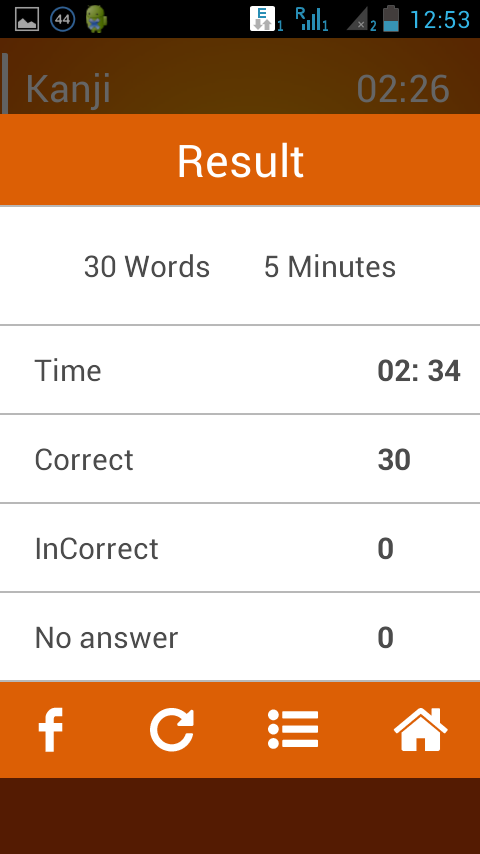
The N5 JLPT app I am talking about is by V-Next software. It’s been very helpful to me. It has got 4 sections in all – Kanji, Vocabulary, Grammar and Search. This app basically is for testing yourself. It has predefined time for particular number of questions (for example 5 minute for 30 questions) and after you take the test it gives you details of no. of questions you attempted, got correct and incorrect.

N5 JLPT App

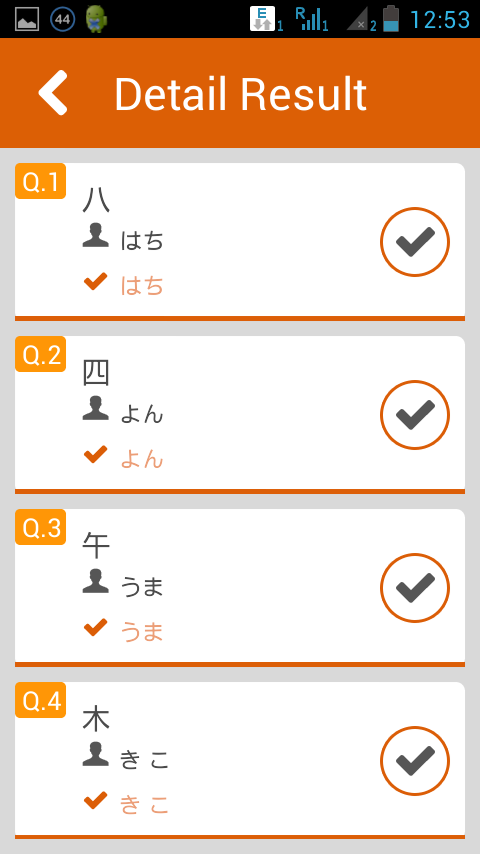
For Kanji section, there are 5 types of time settings – 30, 40, 50, 60 and 70 words in various time limits. This section was the most helpful. But here is a twist. It mostly contains KUNYOMI of the kanji ONLY. That’s why, it is not solely enough for a person preparing for JLPT. BUT, if you keep reviewing kanji from this app, you would become master of distinguishing between onyomi and kunyomi.

N5 JLPT App 2

N5 JLPT App 1

What I used to do was, I used to take a test as soon as I  would wake up. That reminds me, the English meaning are also not given in this section. That means, you’ll have to go to a dictionary to check out the meaning of a kanji you are encountering for the first time. But that was fun and educational in a way too.

N5 JLPT App 3

N5 JLPT App 4


Next comes vocabulary section. Word with very difficult kanjis are given and you need to figure out the meaning in English. Another drawback – no furigana is available for you. Just the kanji and four options in English. Although they do provide kana after the test is finished and you need to check the solutions. I didn’t use it much (though I should’ve). Again, six type of word and time setting – 30, 50, 70, 90, 100, 200 words.

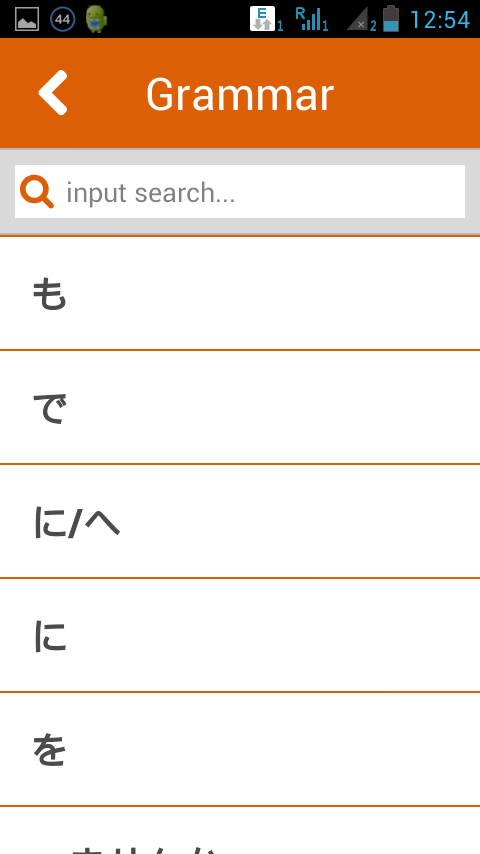
Next is grammar. Until and unless, you don’t know the rules, this section is pretty much useless. They have got lots and lots of examples for the related grammar point but again, one needs to actually know stuff, y’know?

N5 JLPT App 6

N5 JLPT App 6

Search is, as name suggests, simple search. They claim to have around thousand words and you can search by English or Japanese.

N5 JLPT App 5

Yup, so this is pretty much all about it. But the best part is, it’s completely offline. Yeah, sometimes, you don’t get internet access and sometimes you don’t want to use it (mainly to save battery in my phone), that’s when these kind of apps are really a life saver.

This actually might not be the best app out there but with very less memory and time consumption, this worked wonders for me. Just 5 minutes a day. Even reviewing anki flash cards takes a lot more time than this. That’s why I love this app.

Improving reading skill – Short stories (Updated)

Improving reading skill – Short stories (Updated)

I’ve been getting lot of topics to write lately, that I can’t resist blog posting. And when I really really want to write, I run out of ideas! So ironic! Anyways, I’ve been reading short stories now-a-days to improve my reading and speaking skills. And because I come across a lot of new words, vocabulary part is a bonus.

Although, many a times, it is really really difficult. I sometimes just throw the papers in frustration. But in the end, I pick them up again and start from the beginning. Since, I won’t be able to learn the stories in two or three readings except the words I already know, I can go to the same story again which I’ve already read.

It has been pretty hard for me to find stories online so that I can print them and read them, and sometimes I feel webtoons would be much better for entertainment and reading for Korean. But my schedule involves remaining glued to my laptop screen as long as I’m awake. Most of the work I do is on my laptop. If not, I’m watching dramas or MVs. If I’m revising flash cards, then it is my mobile screen. Too much strain on the eyes! (Ah! My eyes are already going bad. I don’t know when the optician uncle would be able to find my no.) That’s why, they are becoming a total no no. So I found out some and got them printed – for now, one in Japanese and one in Korean.

In this regard, news articles can do too! But stories are way more interesting. Last time I got an article printed and it’s still there in my bag, eating dust! (I’m sorry dude.) I haven’t even touched it (yet). I’m posting the stories link for Japanese stories, they are a few in number. Korean is only one though. I’m still searching and if I get some more, I’ll add in this post

For Japanese go here – http://life.ou.edu/stories/http://life.ou.edu/stories/

For Korean story go here – http://pds8.egloos.com/pds/200802/04/11/Episode_41_Worksheet.pdf

Side Story 1 – When my cousin went to China, I was so envious. Now my mentor is going to Japan. JAPAN! I’ve asked her to bring me souvenirs and I’ll try for books. That reminded me, I was searching for big book stores in Bangkok and there are plenty and at those places where I’ve already visited. I never noticed them *Facepalm*. If I had noticed them earlier, I would’ve spent my money on buying books instead of clothes. TT_TT (Now I’m a poor person)

Side Story 2 –  I’m using company’s waste papers for my printing. Here, they generally print on one side and the waste papers are either shredded and then sent to recycle or less important things are printed on the other side – much later. This time, after audit, there were many papers which were deemed to be waste but now I’ve found out the way to use them. Even for my writing, I’m using those only. (One more way to save money, yes!)

Today’s Song – After such a long time, I’ve found an idol group which solely is dominating my playlist. Yes, you guessed right. That is EXO. I already said that I am totally drooling over their charisma would be getting involved with their songs later than the variety shows. Now, not one day passes me without watching the MVs. I wake up and first thing I do is watch them before doing anything. And last thing before going to bed is their songs again. So, today’s song will be –

Update 22/12/2013: Aigoo!! Why didn’t I see this when I was in Thailand? So many worksheets are there and I was searching for them. Anyways, there are a lot of stories here and much more apart from that. So enjoy – http://freshkorean.com/free-resources/

Link

Mistakes we make while learning Kanji

Mistakes we make while learning Kanji

No matter what, this article needs sharing. For all those people like me, who are attempting to learn Kanji and have not reached there yet, we can try changing our approach and this article is perfect for that.

Pegasus SERIES 6!

Pegasus SERIES 6!

This all is free? Whoa!
I finally get some concrete course which will keep me engaged and make it compulsory to attend and not miss out on classes.

Pegasus Society for Korean Studies's avatarThe Pegasus Society

The Pegasus Society for Korean Studies 2013 

Series 6 

-Application Form & Series Information – 

Dear Applicant, 

I am very pleased to introduce to you a new, exciting opportunity to learn the 

Korean language free of charge, also with the addition of further opportunities to expand 

your general Korean Studies knowledge in other areas, and to integrate other languages 

and language skills into your course. 

In Series 6 the Pegasus Society will aim to provide for you an intensive, vigorous 

and thorough training in the Korean language, whether it be our Beginner’s, Intermediate, 

or Advanced level. We hope to provide this to you through the combined teaching of 

Korean Studies university students and graduates, as well as native Korean speakers, 

allowing you to immerse yourself in the four main language areas of reading, writing, 

listening and speaking. 

Our courses are largely conducted via the internet calling programme Skype. We 

offer…

View original post 846 more words